
Wednesday, August 30, 2006
Rogue, Rogue!
After several attempts, rogues finally broke into our yard two nights ago. They broke into Shaun's truck and stole the radio, and they cut the screen of our porch and came in for the plastic chairs. Nothing major, but still unnerving considering the fact that we were at home, and that we had two security guards on duty who were supposed to be awake all night keeping watch. The funny thing is I always get up to investigate every little noise, but I heard nothing. The good thing is Shaun has now been spurred into action on taking more safety measures. He got two fire extinguishers - one for our residence and one for his office, which is right next door - and he has hired a 4th security guard so that there'll always be three on duty. Today the welders are here building a tall wire mesh fence around the office and putting up another gate, all with razor wire on top.


Thursday, August 10, 2006
A Place Called Puduken
 There are about 14 towns in the Nyemonweh Chiefdom of Maryland County, Harper District. According to my guide, Nyema Nevis, Puduken (pop. 550) was built in 1832 and is the least developed town of the Chiefdom because it is the only one separated from Cape Palmas by the ocean. There are no schools there, and those who leave to get an education elsewhere normally do not return. Nyema's own brother left for the USA in 1983 and the family has been trying to trace him ever since.
 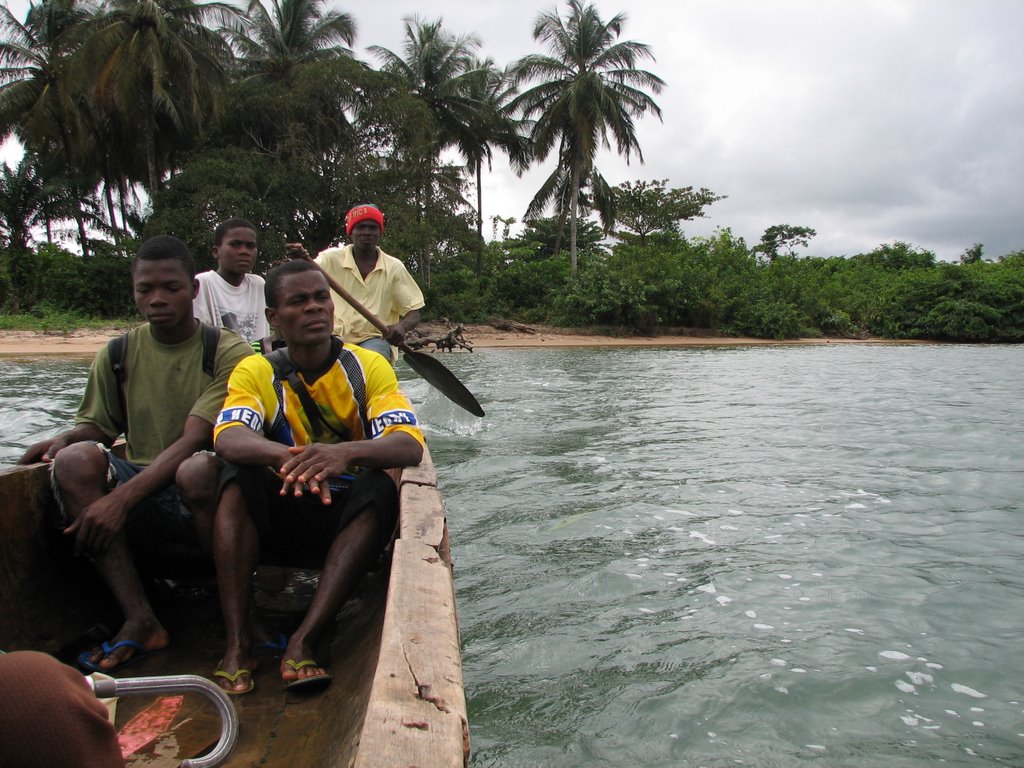 It is a short canoe ride to get to Puduken, where much of the town's livelihood comes from the cassava and eddoes that grow extraordinarily well in the sandy soil. Nyema's father, John Nevis, is the Town Chief of Puduken. Born in 1921, he has lost his eyesight but is still very much in charge and very highly respected. Before the war, he served as Speaker for the Grebo People of Nyemonweh Chiefdom and represented them in audiences with President William V.S. Tubman and President William R. Tolbert. Today, his request on behalf of his Chiefdom, if he could speak to President Ellen Johnson-Sirleaf, is for a bridge to connect Puduken with the mainland so that development will reach his people.
Wednesday, August 09, 2006
The New Dog

Skipper (left) with the new dog (right). We've been calling him "The New Dog" for two weeks now. Any good suggestions out there? Help us, please! (-:
Wednesday, July 26, 2006
Lights!
 On Tubman Boulevard, Congo Town, Independence Day 2006.
 When the lights were tested on Monday, July 24th, the rejoicing in the streets was very much like it was the day we heard Ellen Johnson Sirleaf had won the Presidency. Even those of us who use generators here could not help but cheer. It's wonderful to see that we, as a nation, are moving forward.
Monday, July 24, 2006
Justice for Saah Samukai
At last! After a lengthy trial, three suspects were convicted today for the murder of Saah Samukai.
After Saah's funeral last October, we stood with his mother in the hospital and didn't know what to say (see "Heaven Cried Too"). Back then I don't think we even believed justice was possible; people literally do get away with murder here all the time. Case in point: the convicted men are only three of the 11 armed robbers that attacked the Samukai family that night, and if Mrs. Tamba (as I call Saah's mother) had not thrown acid on one of them, they may never have been caught.
I didn't know what to say that day in the hospital, but a month later, when I saw an ad in the paper for a short-term media consultancy on an arms control project, I knew what I had to do to be a part of the solution. That short-term consultancy has turned into a full-time communications job and news of the verdict makes it extra sweet.
Although the frontpage headline of the Daily Observer says the killers face hanging, it's hard to believe that they will have to pay for their crime. Is this really the beginning of a new day in our justice system? Will there really be justice for Saah Samukai? We can wait and see, or we can rise up - individually and collectively - to make sure justice is served.
After Saah's funeral last October, we stood with his mother in the hospital and didn't know what to say (see "Heaven Cried Too"). Back then I don't think we even believed justice was possible; people literally do get away with murder here all the time. Case in point: the convicted men are only three of the 11 armed robbers that attacked the Samukai family that night, and if Mrs. Tamba (as I call Saah's mother) had not thrown acid on one of them, they may never have been caught.
I didn't know what to say that day in the hospital, but a month later, when I saw an ad in the paper for a short-term media consultancy on an arms control project, I knew what I had to do to be a part of the solution. That short-term consultancy has turned into a full-time communications job and news of the verdict makes it extra sweet.
Although the frontpage headline of the Daily Observer says the killers face hanging, it's hard to believe that they will have to pay for their crime. Is this really the beginning of a new day in our justice system? Will there really be justice for Saah Samukai? We can wait and see, or we can rise up - individually and collectively - to make sure justice is served.
Sunday, July 23, 2006
A Welcome Public Notice
 A welcome notice on a new light pole near the YWCA, Congo Town, Monrovia. Liberia has not had public lighting for 16 years!
Monday, July 03, 2006
Mexco Zidane's Ataye Shop
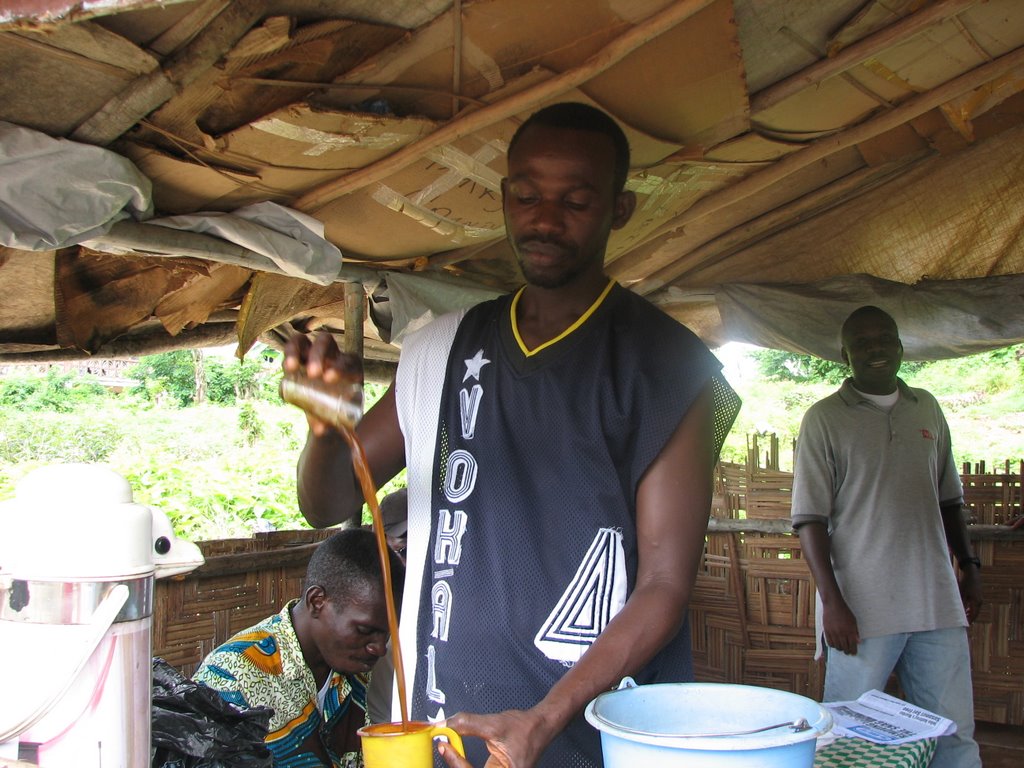 Ataye Shops are a fairly new phenomenon here in Liberia. "Ataye" is a strong tea served in tiny glasses. The fun is in the mixing of it. The server puts the already brewed tea in a small plastic cup, puts in some sugar, and, instead of stirring, he pours the tea from the plastic cup into the glass and vice versa several times (in a very long stream) to mix it.
Ataye shops have become men's clubs ("because women don't like the strong flavor of the tea," someone explains to me) and are always alive with discussions, debates and answers to Liberia's problems. Today, at Mexco Zidane's Ataye Shop on Maryland Avenue in Harper City (Maryland County), the talk is about who should win the World Cup. I'm not really following the argument but I hear the words "Ronaldinho" "Brazil" "Portugal" "France" and something about unequal match-ups and some country taking all the African players. Mexco (aka Mohammed) offers me my very first glass of Ataye. I say no at first, but he insists and I accept. It is strong, but surprisingly sweet and not at all unpleasant.
Tuesday, June 27, 2006
Welcome to Whole Graway
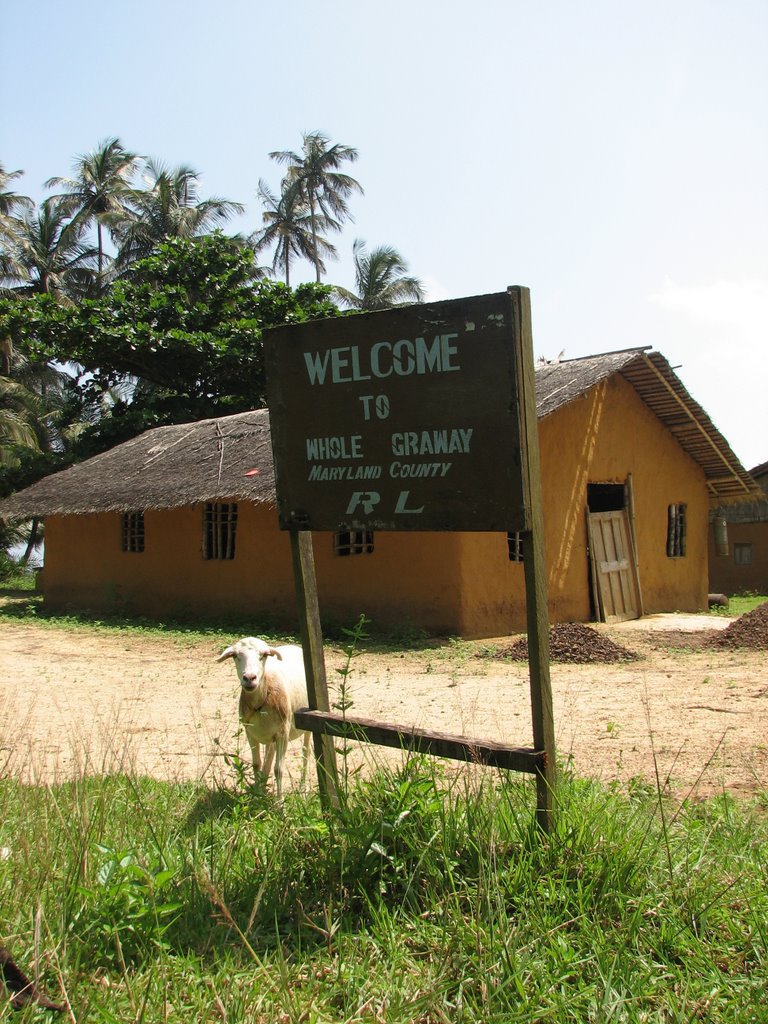 About an hour's drive from Harper City, Maryland County, along a dusty road winding through lush green landscapes that make one dream of building a sprawling vacation home far from the madding crowd, there is a large town called Whole Graway. (And yes, there is a smaller town nearby called Half Graway!) Whole Graway (pronounced erroneously by most people as "Ho Gravy") is the heart of the Nyemoweh Chiefdom. Situated right near the palm-lined beach, the houses are large mud structures, usually square or rectangular, with thatched roofs. The round structures with cone-shaped roofs are the kithcens -- often shared by more than one family. There are around a hundred houses in the town, but because it is the middle of the day, it is peaceful and quiet. Most of the adults have gone to the farms, leaving behind the elderly, the very young, and the goats who run ahead of our vehicle to warn everyone that strangers have come to visit.

Tuesday, June 20, 2006
Communication for the Nation
 Lonestar Cell was launched in Pleebo and Harper Cities the day I arrived in Maryland County. What a relief! From Foya City in Lofa, to Harper City in Maryland – Lonestar Cell has the widest coverage, the clearest connection, and the best customer service...by far!
Monday, June 19, 2006
River Gbeh
 Once upon a time, Liberia was divided into 13 Counties. River Gee and Gbarpolu Counties were created in recent years, bringing the number of counties to 15. There are two rivers running through River Gee County: River Gee, and River Gbeh. River Gbeh is the most powerful, with waves flowing fast and crashing noisily against the rocks. Makes one wonder why the county was named River Gee instead.
Sunday, June 18, 2006
Muddy Boots
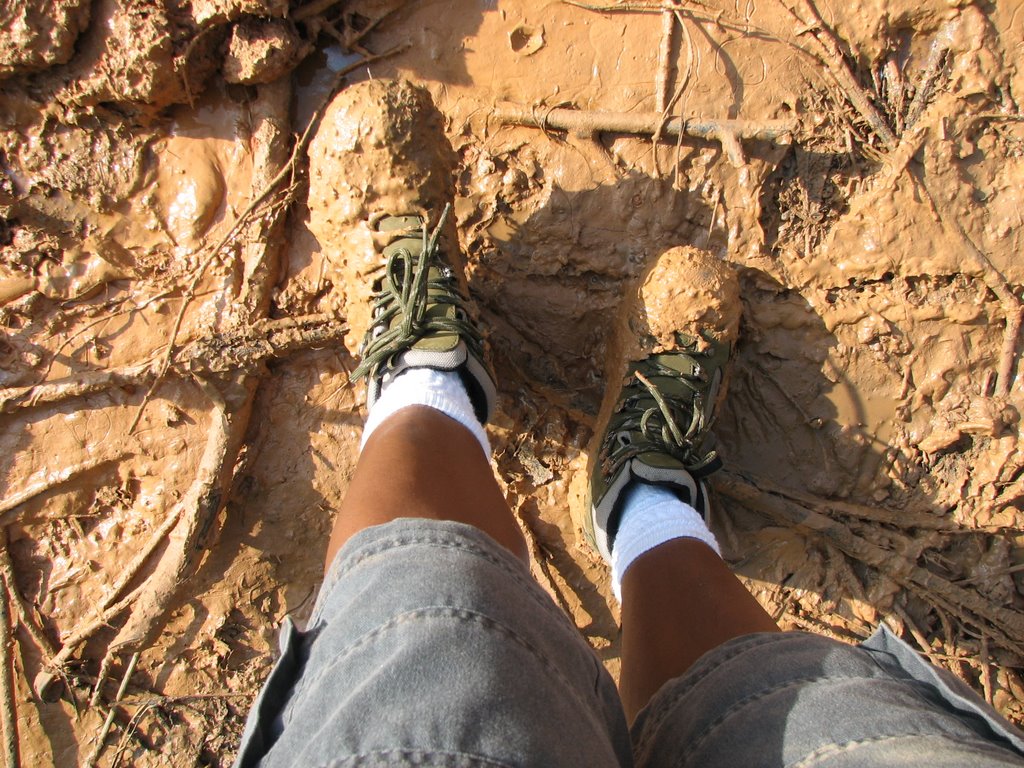 I ordered my waterproof hiking boots online, and when they arrived I thought I had overdone it. Even though I had heard stories of the Rainy Season upcountry roads (some with stretches so bad they have names), the boots looked and felt too serious for little old Liberia. Boy, was I wrong! I’m using them for the first time on a trip to River Gee County in the less-traveled southeastern region of the country.
 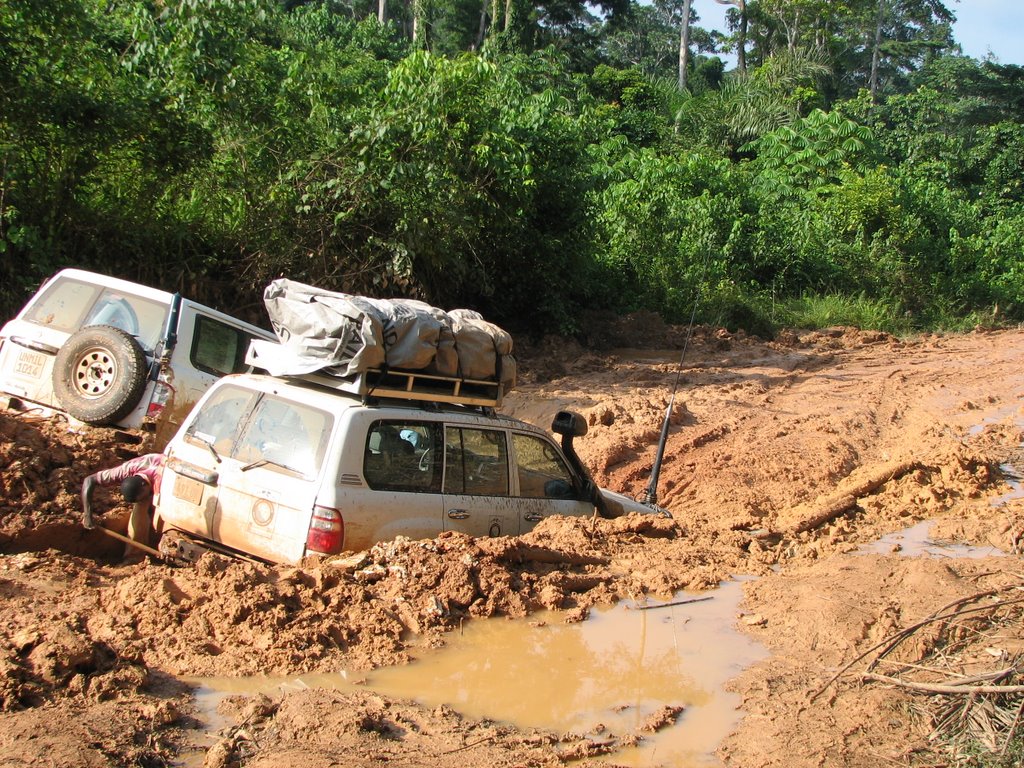 Even though it didn’t rain much during the days leading up to our journey, what did come from the sky was enough to turn the infamous parts of the unpaved “highway” into bowls of mud soup and traps of sticky red clay. When we aren’t stuck in one for hours struggling to get ourselves out, we’re stuck waiting for hours for other unfortunate souls to get out first. While we wait I love plodding around in the mud with confidence (and an air of experience in rough terrain). It’s also satisfying to know that if we have to hike several miles to the nearest village my boots will be adequately challenged.
Thursday, April 27, 2006
"What's New for April?"
That was a question posted on Liberia Stories earlier this month.
Well, what's new for April is actually old. After a full year of searching for the perfect words (and not finding them), I have decided to just go ahead and post some of the pictures I took last April at the 25th Anniversary Memorial Celebration for the 13 government officials killed on April 22, 1980, shortly after the coup d'etat. They are posted along with the draft I wrote back then.
I think another reason it has taken me so long to share what I have is that no images can adequately convey the sheer power of that day.
I have posted each picture separately (in the April 2005 folder) so that relatives and friends can add comments and personal memories. I, too, will post the perfect words as they come to me.
Please Note: You do not have to set up your own blog to make a comment. You may use the "anonymous" identity, and write your name (if you wish) in your post.
Well, what's new for April is actually old. After a full year of searching for the perfect words (and not finding them), I have decided to just go ahead and post some of the pictures I took last April at the 25th Anniversary Memorial Celebration for the 13 government officials killed on April 22, 1980, shortly after the coup d'etat. They are posted along with the draft I wrote back then.
I think another reason it has taken me so long to share what I have is that no images can adequately convey the sheer power of that day.
I have posted each picture separately (in the April 2005 folder) so that relatives and friends can add comments and personal memories. I, too, will post the perfect words as they come to me.
Please Note: You do not have to set up your own blog to make a comment. You may use the "anonymous" identity, and write your name (if you wish) in your post.
Thursday, March 23, 2006
The Fish Gods of Gbaota
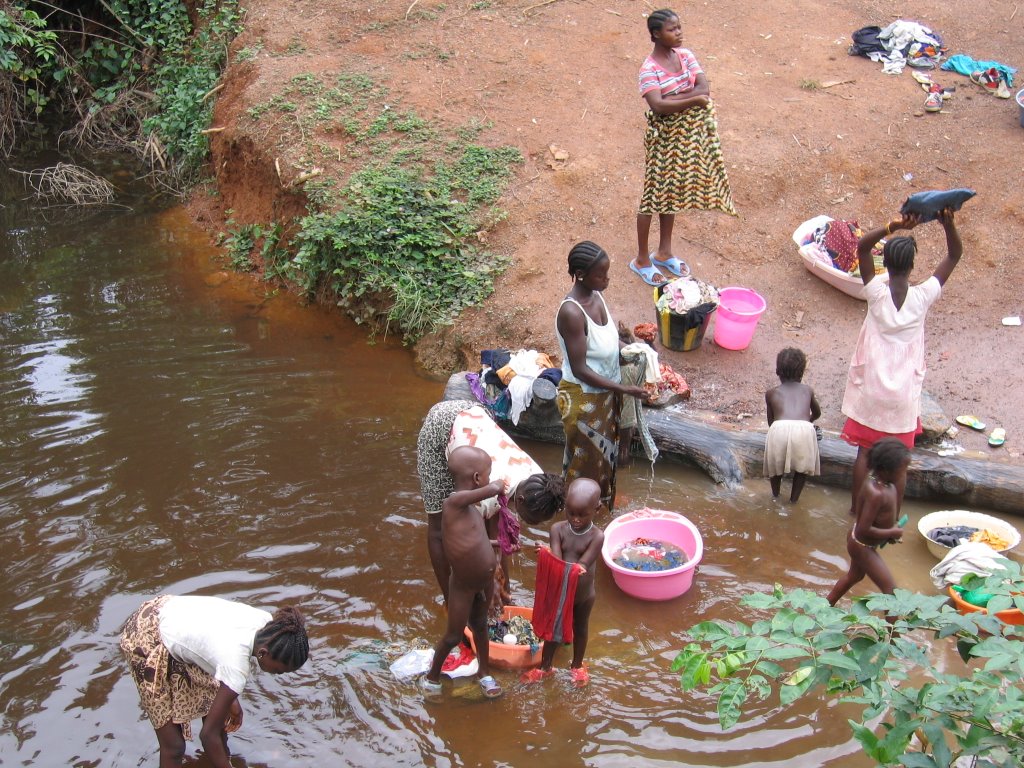 Almost three hours out of Monrovia, on the highway to Gbarnga, there is a little town with an infamous river running through it. One part of the river is used for bathing and washing clothes, and another part is full of giant catfish that have lived there unmolested since the olden days. They come to the surface in a wild thrashing frenzy if you throw pieces of bread in the water. During the civil war, I am told, when there was no food and people were so hungry that they ate rats, lizards, and even other human beings, no one even considered catching the fish of Gbaota.
 Legend has it that long ago, before the war, people used to bring their problems to the fish. After such visits, which were made in consultation with certain gifted people from the town, all sorts of requests would be granted. Even women who went there with infertility problems would finally bear children. But anyone who dared to eat the fish would fall into misfortune and ill health, and die.
Town Chief Harrison Cooper says once a group of people began fishing there, claiming that as Christians, no harm would come to them if they ate the fish. “They saw for themselves,” Cooper added with a shrug, “and they stopped eating the fish."
There are other tales regarding the fish of Gbaota River. For one, they say any other fish that enters their space turns up dead, and that any Gbaota catfish who crosses a certain boundary in the river cannot turn back; it loses its power and becomes safe to eat.
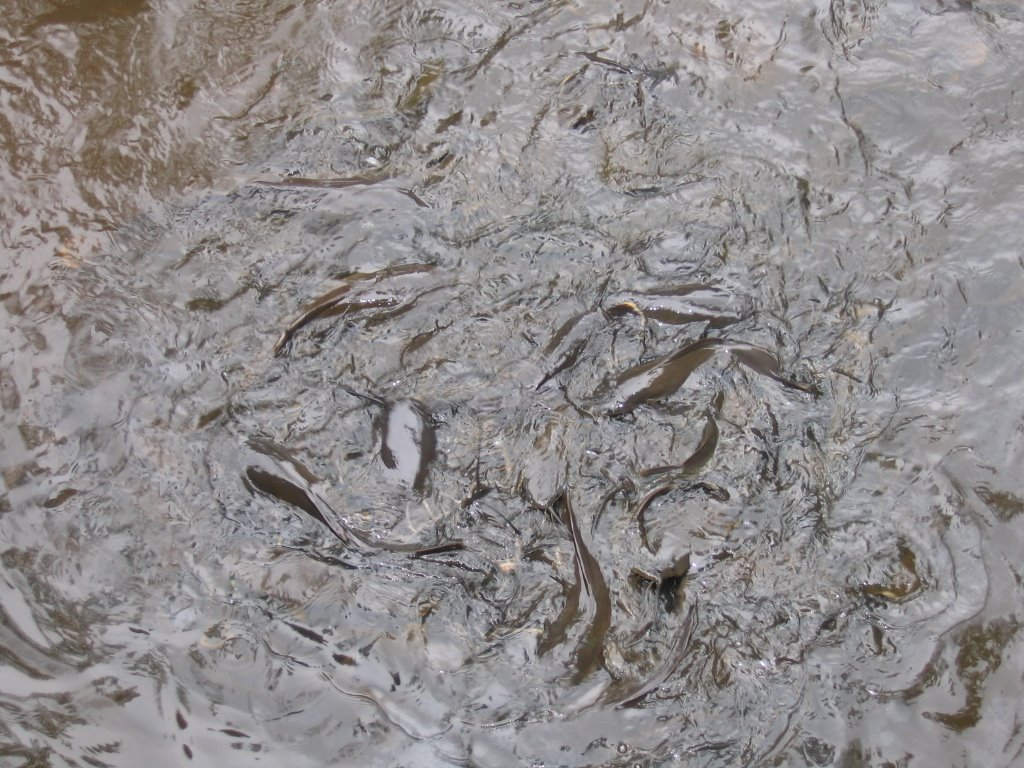 The Town Chief warned that my taking photographs of them would prove useless. “Plenty people try to take their picture,” he said, “but the pictures never come out.” With that in mind, I had an eerie feeling all the way back to Monrovia. Would my digital photos disappear? Paranoid, I kept checking on them. Would we be able to see the fish in the photos? Would my photo of the three young Gbaota girls download as two old women with missing teeth and one with long flat breasts? Would the fish gods of Gbaota let me tell their story??
 (Well, here they are! Apparently the fish appreciated the Fanti bread I threw in. However, if the blog starts to act up we'll all know why.)
Gbaota Girls
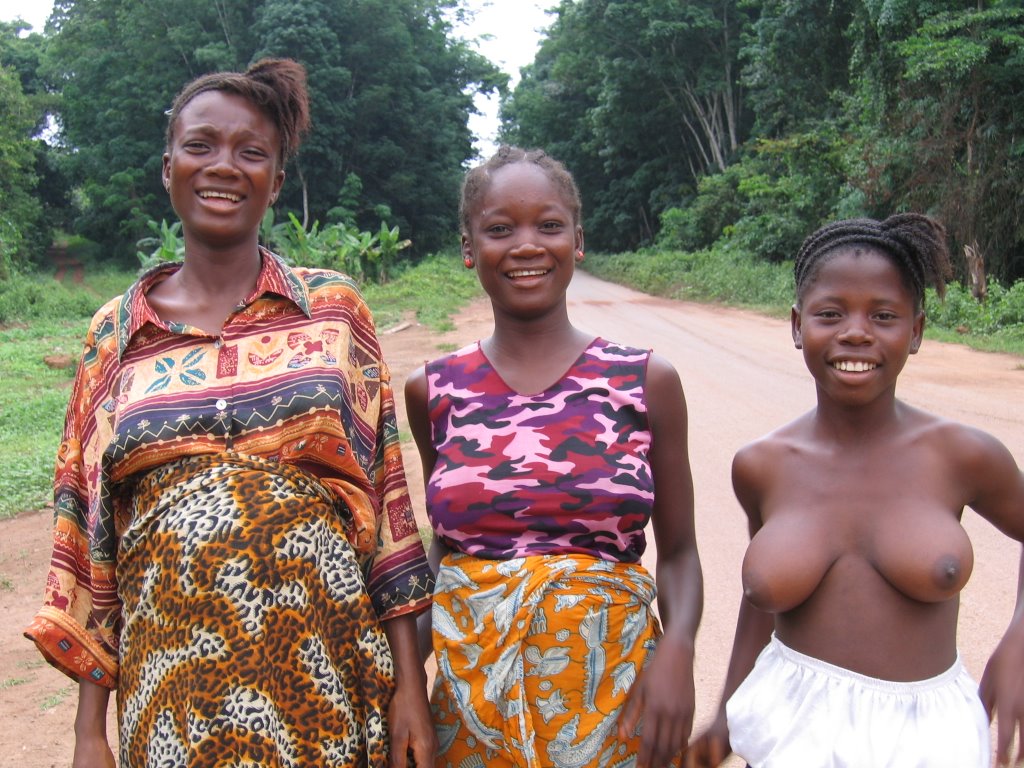
(L-R) Teta, Tutu-Girl and Annie, who pulled her tube top down and insisted on showing her titties for the picture (Gbaota Town, Bong County)
Sunday, February 19, 2006
Foya Rebel Fortresses
Foya, Lofa County
One of the most remarkable things about Foya is that years after the fighting, homes and buildings still bear the marks and warning signs of the rebel forces who terrorized the citizens there.
I asked people why they keep these reminders of such a traumatic time. Someone explained that they're waiting for the owners of the abandoned buildings to come back and fix up their places. Some of those living in marked houses said they simply don't have any paint.
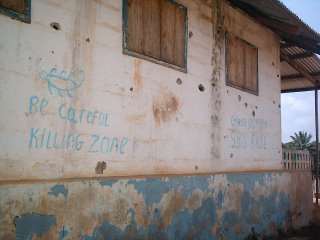
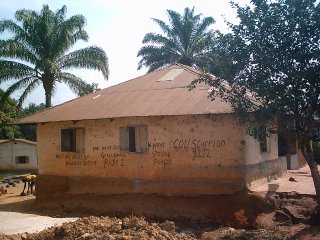

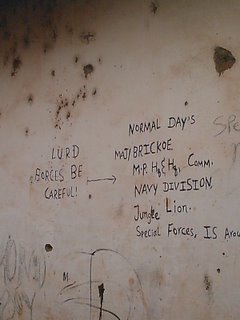
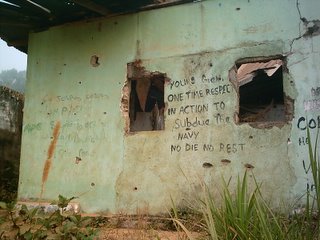
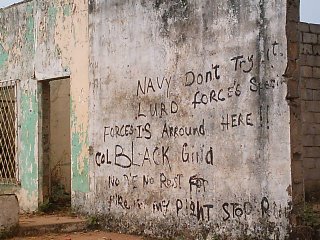
If you want to help give Foya a facelift so that the children don't grow up thinking this is normal, please contact me.
One of the most remarkable things about Foya is that years after the fighting, homes and buildings still bear the marks and warning signs of the rebel forces who terrorized the citizens there.
I asked people why they keep these reminders of such a traumatic time. Someone explained that they're waiting for the owners of the abandoned buildings to come back and fix up their places. Some of those living in marked houses said they simply don't have any paint.
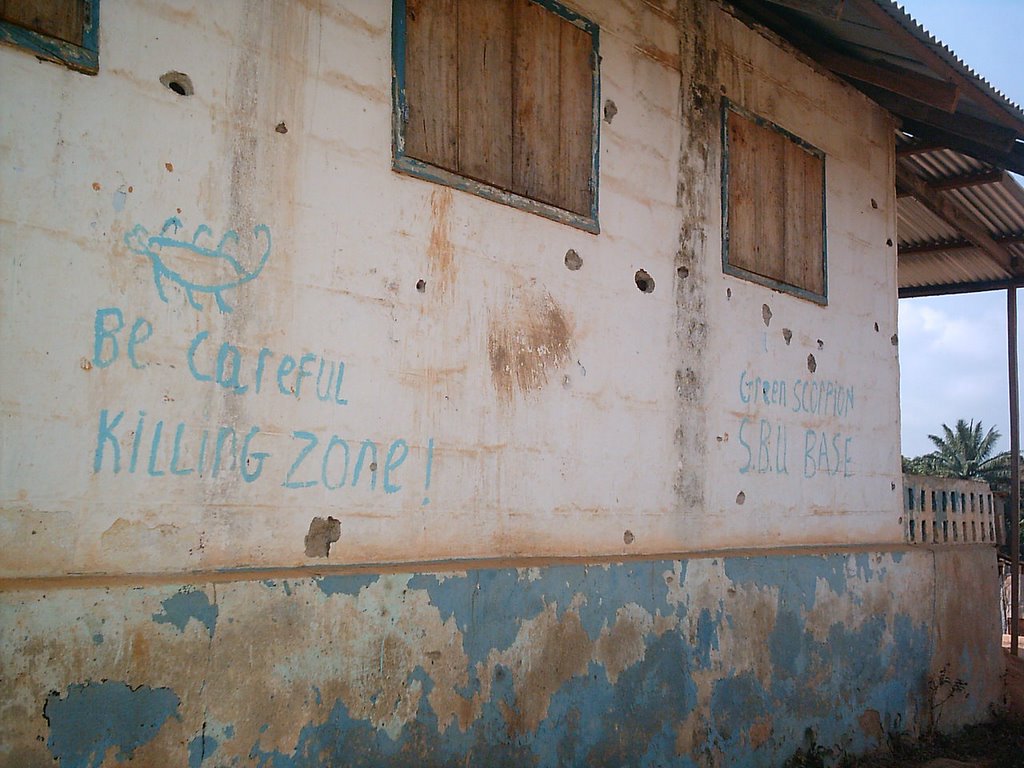

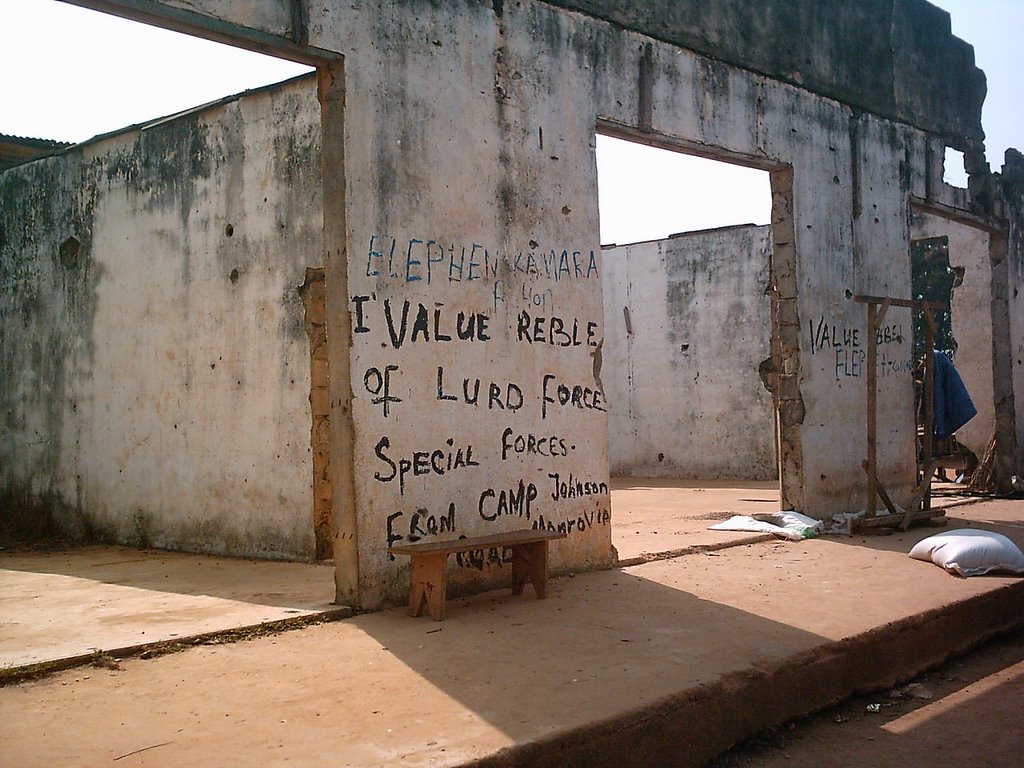

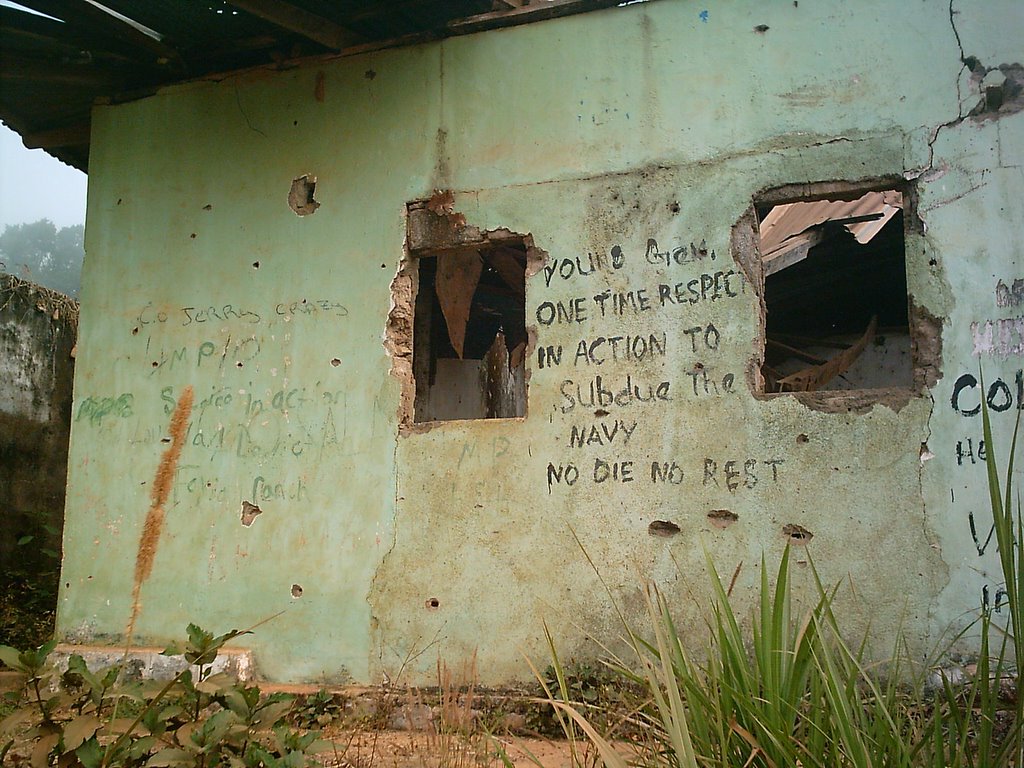

If you want to help give Foya a facelift so that the children don't grow up thinking this is normal, please contact me.
Saturday, February 18, 2006
Making Country Cloth
Foya, Lofa County
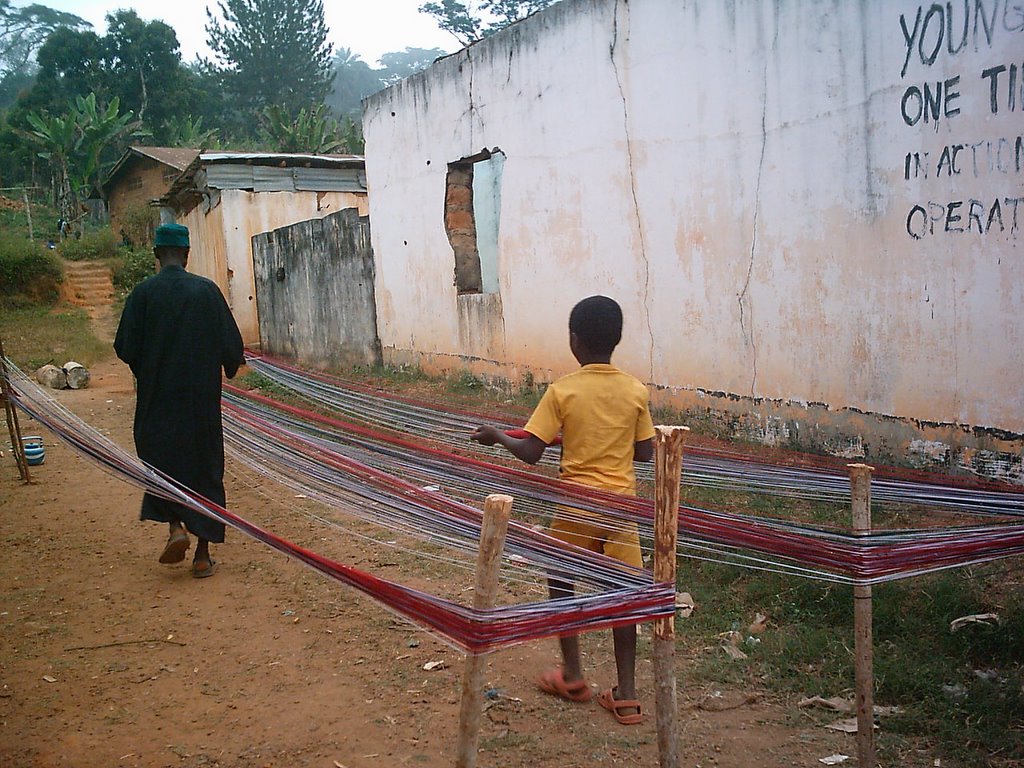
Mohammed Sheriff, Imam of Foya City, leads prayers at the mosque and teaches his son how to make country cloth -- just as his father taught him. They will weave the colorful yarn into a thick, striped cloth to be used for shirts, gowns, hats, and other items.


Mohammed Sheriff, Imam of Foya City, leads prayers at the mosque and teaches his son how to make country cloth -- just as his father taught him. They will weave the colorful yarn into a thick, striped cloth to be used for shirts, gowns, hats, and other items.


Friday, February 17, 2006
Towo Finda's Fishing Nets
Foya, Lofa County
 Towo Finda makes fishing nets with rope made from fibers found in leaves from the palm tree. You fold a long thin leaf in half, and, from the crease, peel away to expose the fine green fibers. The fibers are then twisted together into a thin rope and laid out to dry.
When fishing season rolls around, women go out in small groups and wade into the water with their nets. They gently shake the nets underwater to lure in the fish. Towo Finda says she used to fish herself, but had to stop for health reasons. For several years now, she has made nets only to sell. It takes about a week to make a good net that will last for several years.
 Towo Finda makes fishing nets with rope made from fibers found in leaves from the palm tree. You fold a long thin leaf in half, and, from the crease, peel away to expose the fine green fibers. The fibers are then twisted together into a thin rope and laid out to dry.
 When fishing season rolls around, women go out in small groups and wade into the water with their nets. They gently shake the nets underwater to lure in the fish. Towo Finda says she used to fish herself, but had to stop for health reasons. For several years now, she has made nets only to sell. It takes about a week to make a good net that will last for several years.
Thursday, February 16, 2006
Wednesday, February 15, 2006
Edwin Kpongo, Brick Maker
Foya, Lofa County
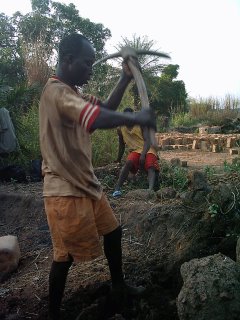 Edwin Kpongo and his friends earn a living making bricks out of mud. Each man on the team makes 200 blocks per day, and gets paid $200 Liberian Dollars for his labor. The blocks take up to 15 days to get dry. During construction they are put together with cement, and then plastered. With the plaster and a roof for protection, mud houses last for many years.
 Edwin Kpongo and his friends earn a living making bricks out of mud. Each man on the team makes 200 blocks per day, and gets paid $200 Liberian Dollars for his labor. The blocks take up to 15 days to get dry. During construction they are put together with cement, and then plastered. With the plaster and a roof for protection, mud houses last for many years.
Subscribe to:
Posts (Atom)